This section is going to allow you to learn about:
- Functions and their Graphs;
- Exponents and Logarithms;
- The Remainder and Factor Theorems;
- Equations and Inequalities.
We will:
- Revise symmetric and skewed data;
- Use statistical summaries, scatterplots, regression (in particular the least squares regression line) and correlation to analyse and interpret bivariate data.
- Use the concepts of interpolation, extrapolation and skewness.
We will look back at knowledge gained in earlier grades, but add to this as follows:
- The necessary and sufficient conditions for polygons to be similar;
- Proportionality in triangles;
- Equiangular triangles are similar;
- Triangles with sides in proportion are similar;
- The theorem of Pythagoras.
You will define and apply the following concepts:
- Limits;
- The derivative of a function;
- First principles;
- Rules of differentiation;
- How to find the equation of the tangent to the graph of a function;
- The second derivative, and how it determines the concavity of a function;
- How to sketch the graph of a cubic polynomial function;
- How to solve practical problems concerning optimisation and rate of change, including the calculus of motion.
We will do:
- Arithmetic, geometric and quadratic sequences;
- Arithmetic and geometric series (progressions);
- The infinite geometric sequence and series;
- Sigma notation;
- How to derive and apply the formulae for the sum of arithmetic and geometric series.
We will derive and apply the following things:
- The equation of a line through two given points;
- The equation of a line through one point and parallel or perpendicular to a given line;
- The inclination (θ) of a line, where m = tanθ is the gradient of the line (0o ≤ θ ≤ 180o);
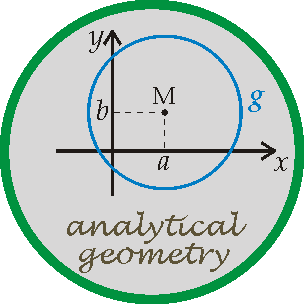
Also, the equation below defines a circle with centre (a; b) and radius r:
(x – a)2 + (y – b)2 = r2
We will:
- Solve problems related to such a circle;
- Determine the equation of a tangent to a given circle.
Here is the menu:
- We will review the basics;
- You will see how the sine and cosine functions are formed;
- Reduction formulae;
- Compound and double angles;
- Trigonometrical functions and their graphs;
- Solving triangles in the context of 2-D and 3-D problems.
Skills to acquire:
- How to rotate a point through 90o — anticlockwise about the origin
- How to rotate a point through 90o — clockwise about the origin
- How to rotate a point through 180o about the origin
- How to translate a point through a units along the x-axis and b units along the y-axis
- How to reflect a point in the x-axis
- How to reflect a point in the y-axis
- How to reflect the graph of a function in the - and -axes
- How to find the reflection of a point in the straight line
- How to sketch the inverse of a function
- How to enlarge or reduce a figure by a scale factor
- How to rotate a point through an angle anticlockwise about the origin